Wash Basin Size Guide: How to Choose the Right Basin for Your Bathroom
A wash basin may look perfect in a showroom but feel completely different once it is installed inside your bathroom.
The right basin should fit comfortably within the available space, work properly with the faucet and leave enough room for everyday movement.
This Wash Basin Size Guide explains seven important points to check before choosing a basin for a new bathroom or renovation.
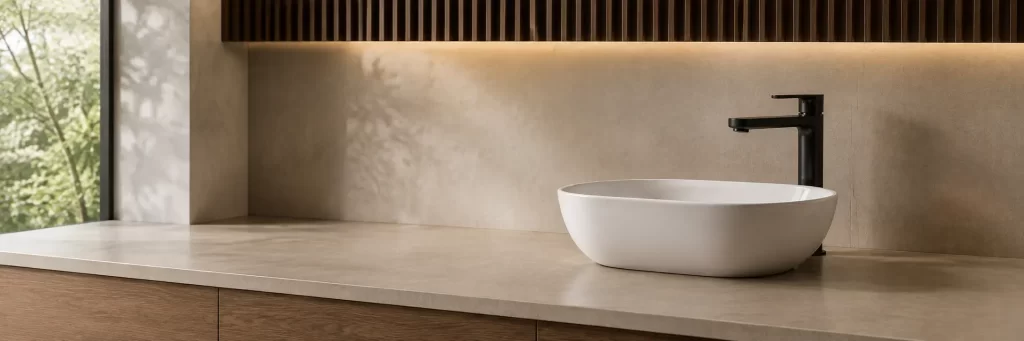
1. Measure the Available Space First
A practical Wash Basin Size Guide should always begin with accurate bathroom measurements before product selection.
Check:
- Available wall width
- Available counter depth
- Distance from the WC
- Shower area
- Door movement
- Storage requirements
- Plumbing position
Do not select the basin first and try to fit everything else around it later.
The bathroom layout should guide the basin size.
A compact bathroom may need a smaller basin, while a larger master bathroom gives you more freedom to use wider countertop or vanity designs.
2. Understand the Main Basin Types
Different basin styles use bathroom space differently.
Countertop Basin
A countertop basin sits above the counter.
It can create a strong visual feature and works well in modern bathrooms.
However, the height of both the counter and basin should be considered together.
A deep or tall basin placed on an already high counter may become uncomfortable to use.
Wall-Hung Basin
A wall-hung basin is fixed directly to the wall.
It can be useful where floor space is limited because there is no full vanity cabinet underneath.
Some designs can also be combined with a pedestal or half pedestal.
Under-Counter Basin
An under-counter basin sits below the countertop surface.
This creates a clean counter edge and leaves more visible countertop space.
It is commonly considered for bathrooms with built-in vanity counters.
Corner Basin
A corner basin can be useful for very compact bathrooms, powder rooms or areas where the main wall space is limited.
The best type depends on the bathroom layout rather than appearance alone.
3. Choose the Basin Width According to the Bathroom
This Wash Basin Size Guide also helps you compare basin width with the available counter and walking space.
One of the most important parts of a Wash Basin Size Guide is basin width.
A very wide basin can dominate a compact bathroom.
At the same time, a very small basin may feel uncomfortable in a large family bathroom.
Current sanitaryware ranges demonstrate how much basin dimensions can vary. Compact options can be around 420 mm wide, while larger countertop models can extend beyond 700 mm.
The correct size should leave enough space around the basin for comfortable movement and cleaning.
Before buying, mark the approximate basin width on the wall or counter with tape.
This simple step can help you understand the actual scale better than looking only at product photographs.
4. Basin Depth Is Just as Important as Width
Customers often focus on width but forget the front-to-back depth of the basin.
A basin that projects too far from the wall can make a narrow bathroom feel crowded.
This becomes particularly important when the basin faces:
- A WC
- A shower enclosure
- A door
- A narrow walking passage
For a compact bathroom, a shallower basin may provide better circulation.
For larger bathrooms, additional depth may be comfortable if enough space remains around it.
Always check the complete product dimensions before ordering.
5. Match the Faucet With the Basin
The basin and faucet should be selected together.
A beautiful basin combined with the wrong faucet can create splashing or uncomfortable handwashing.
Consider:
- Basin height
- Basin depth
- Faucet height
- Spout length
- Faucet mounting position
- How far the faucet spout reaches into the basin
For a countertop basin, you may need a tall-body faucet or wall-mounted faucet depending on the basin design.
A basin with an integrated tap hole may use a different faucet arrangement.
The water stream should ideally fall comfortably into the bowl instead of hitting the edge of the basin.
This is why it is better to finalise the basin and faucet as one combination.
6. Consider Counter Space and Storage
The basin is only one part of the vanity area.
Think about what else you normally keep around the basin:
- Soap
- Toothbrushes
- Toiletries
- Grooming products
- Towels
A very large basin may leave little usable counter space.
For a family bathroom, a slightly smaller basin with more surrounding counter space may sometimes be more practical.
You should also decide whether you need storage below the basin.
If a vanity cabinet is planned, check how the basin, waste pipe and bottle trap will interact with the available storage.
A good bathroom layout balances basin size, counter space and storage.
7. Check the Installation Height Before Finalising
The finished basin height should be comfortable for the people using the bathroom.
This is particularly important with countertop basins because the basin sits above the counter.
Instead of fixing the counter at the normal height first and then adding a tall basin, calculate the final height of the entire setup.
For wall-hung basins, the installation height can be planned directly according to the selected product and user requirements.
Always confirm the final mounting level with the installer before drilling or completing plumbing connections.
Which Wash Basin Is Best for a Small Bathroom?
Using a Wash Basin Size Guide can make it easier to shortlist suitable options before visiting a showroom.
Suitable options may include:
Compact wall-hung basins – useful when you want to preserve floor space.
Corner basins – useful where conventional wall space is limited.
Compact countertop basins – suitable when you still want a modern vanity look.
Before selecting one, make sure the basin does not interfere with the door, WC or shower area.
The smallest basin is not automatically the best.
It still needs to be comfortable enough for everyday handwashing.
Which Basin Works Well in a Master Bathroom?
A larger master bathroom allows more flexibility.
You may consider:
- Wider countertop basins
- Larger vanity counters
- Under-counter basins
- Statement countertop designs
- Double-basin arrangements where space allows
The basin can become an important design element when there is enough room around it.
However, proportions still matter.
A large basin should suit the vanity, mirror and overall wall width rather than looking oversized within the space.
Round, Oval, Square or Rectangular Basin?
Shape is mainly a combination of design preference and available space.
Round and oval basins can create a softer appearance.
Square and rectangular basins often suit contemporary bathroom designs.
But shape also affects usable counter space.
A rectangular basin may fit efficiently along a long counter, while a round countertop basin can leave useful space around its corners.
Instead of deciding based only on style, compare the basin shape with the dimensions of your vanity.
Don’t Forget the Mirror
The basin and mirror should look balanced together.
A small basin with an extremely wide mirror—or a large vanity with a very narrow mirror—can make the wall feel visually disconnected.
Before installation, plan:
Basin + Faucet + Counter + Mirror + Lighting
as one complete area.
This creates a more coordinated bathroom than selecting each item separately.
A Simple Wash Basin Checklist
Before ordering, confirm:
Bathroom dimensions
Basin width
Basin depth
Basin height
Counter dimensions
Faucet type
Tap-hole requirement
Plumbing position
Storage requirement
Mirror position
Following this Wash Basin Size Guide can help prevent many common mistakes before installation begins.
Explore Wash Basins at Floor Collections
Following this Wash Basin Size Guide can help you avoid choosing a basin that is too large, too deep or uncomfortable for the available space.
Customers looking for the right wash basin can explore different sizes, shapes and mounting styles at Floor Collections.
Our Pattambi and Ottapalam showrooms offer sanitaryware and bathroom solutions for compact bathrooms, family bathrooms, master bathrooms and other residential or commercial requirements.
Customers can physically compare basin dimensions, faucet combinations and designs before making their final choice.
Floor Collections also offers tiles, sanitaryware, CP fittings, bathroom fittings, tile adhesives, waterproofing solutions and related home products.
Instead of asking only:
“Which basin looks best?”
also ask:
“Will this basin fit comfortably in my bathroom?”
The right answer comes from balancing size, layout, faucet selection and everyday usability.
Frequently Asked Questions
What is the ideal wash basin size for a bathroom?
There is no single ideal size for every bathroom. The correct basin depends on available wall or counter space, bathroom dimensions, basin type and the clearance needed around nearby fixtures.
Which wash basin is suitable for a small bathroom?
Compact wall-hung, corner and smaller countertop basins can work well in limited spaces. Always check the actual product dimensions and door or WC clearance before buying.
Is a countertop basin good for a small bathroom?
It can be, provided the counter is appropriately sized. Compact countertop basins can create a modern look without requiring a very large vanity.
How do I choose the correct faucet for a wash basin?
Check the basin height, depth and tap-hole arrangement. The faucet spout should reach comfortably into the bowl without causing unnecessary splashing.
Where can I compare wash basin sizes in Kerala?
Customers can visit Floor Collections showrooms in Pattambi and Ottapalam to compare different wash basin sizes, shapes and bathroom-fitting combinations.
